

View lesson
 5 min
5 minTypes and architectures of eVTOL aircraft
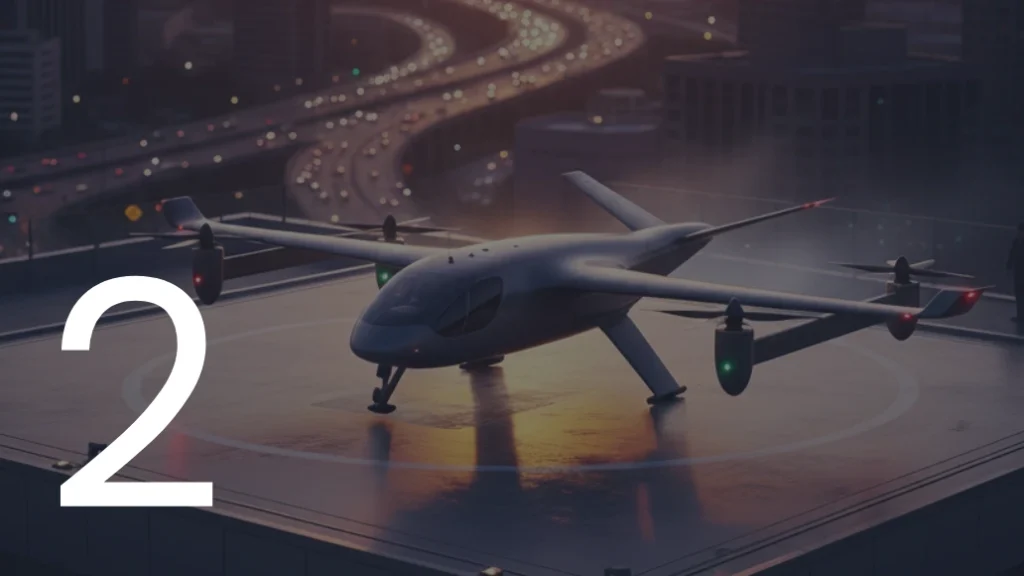

The architecture of an eVTOL aircraft is one of the most decisive factors influencing its performance, safety, certification path, operational feasibility, and economic viability. Unlike conventional aircraft, where a limited number of configurations have dominated for decades, eVTOL development has given rise to a wide variety of architectural concepts, driven by the flexibility of electric propulsion and the absence of traditional mechanical constraints.
This lesson provides a detailed analysis of the main eVTOL architectures, explaining how each configuration works, what technical trade-offs it introduces, and how it impacts flight control, redundancy, energy efficiency, and certification. Understanding these architectures is essential for evaluating design decisions and their implications across the entire eVTOL lifecycle.
Why architecture matters in eVTOL design
In conventional aviation, propulsion and lift generation are tightly coupled through mechanically driven systems. Electric propulsion breaks this paradigm by allowing multiple independent propulsors, distributed across the airframe and controlled electronically. This enables new configurations that optimize different aspects of the mission, such as hover efficiency, cruise performance, redundancy, or noise reduction.
However, this architectural freedom comes at a cost. Each additional propulsor, actuator, and control mode increases system complexity, introduces new failure modes, and raises challenges in flight control and certification. As a result, eVTOL architecture selection is fundamentally a process of balancing competing requirements rather than maximizing a single performance metric.
Multirotor eVTOL architecture
The multirotor eVTOL architecture is conceptually the simplest and most intuitive. It relies exclusively on vertically oriented rotors to generate lift during all phases of flight, including hover, climb, cruise, and descent. Lift is produced purely through thrust, without relying on aerodynamic lift from wings.
From a control perspective, multirotor eVTOLs benefit from direct thrust vectoring, with attitude and position controlled by differential rotor speeds. This results in relatively simple control laws and predictable hover behavior, which is advantageous during take-off, landing, and low-speed operations.
However, the absence of aerodynamic lift during cruise leads to poor energy efficiency. Continuous power is required to counteract gravity, significantly limiting range and endurance. As a result, multirotor architectures are generally constrained to short missions and lower payload fractions.
From a certification standpoint, multirotor eVTOLs can offer high levels of propulsion redundancy, as the loss of a single rotor can often be tolerated. Nevertheless, the large number of motors and power electronics components increases the burden of demonstrating system reliability and fault containment.
Multirotor architectures are therefore more commonly associated with cargo eVTOLs or smaller-scale operations, rather than long-range passenger transport.
Lift + cruise architecture
The lift + cruise configuration separates the functions of vertical lift and forward propulsion. Dedicated lift rotors are used for take-off, landing, and hover, while separate propellers—often mounted in a tractor or pusher configuration—provide thrust during wing-borne cruise.
This separation allows the aircraft to exploit aerodynamic lift from fixed wings during cruise, dramatically improving energy efficiency compared to multirotor designs. Once in forward flight, lift rotors can be shut down or feathered, reducing power consumption.
From an engineering standpoint, lift + cruise architectures simplify certain aspects of flight control, as hover and cruise regimes are clearly separated. However, they introduce additional structural mass and complexity due to the need for multiple propulsion subsystems.
Certification challenges arise from the transition phase, during which lift rotors are disengaged and cruise propulsion takes over. Authorities require clear demonstration that transitions are safe, repeatable, and robust to failures.
Lift + cruise is one of the most popular architectures for passenger eVTOLs, as it offers a strong balance between efficiency, performance, and manageable system complexity.
Tilt-rotor architecture
In a tilt-rotor eVTOL, the same propulsors are used for both vertical lift and forward flight by physically rotating the rotors from a vertical to a horizontal orientation. This allows the aircraft to transition smoothly from hover to wing-borne cruise while minimizing the number of propulsion systems.
The key advantage of tilt-rotor architectures is propulsion efficiency, as all motors contribute to lift and thrust across the entire flight envelope. This can lead to excellent range and cruise performance.
However, tilt mechanisms introduce significant mechanical and control complexity. The tilting actuators become safety-critical components, and failure scenarios must be carefully analyzed and mitigated. Additionally, flight control during transition is highly coupled and requires sophisticated control algorithms.
From a certification perspective, tilt-rotor eVTOLs face some of the most stringent scrutiny, as authorities must be convinced that both mechanical systems and control laws can handle all foreseeable failure conditions.
Despite these challenges, tilt-rotor architectures are attractive for regional mobility use cases, where higher cruise speeds and longer ranges are required.
Tilt-wing architecture
The tilt-wing architecture extends the tilt-rotor concept by rotating the entire wing, along with its propulsors, between vertical and horizontal orientations. This approach can improve aerodynamic efficiency during hover and transition by aligning the wing with the rotor downwash.
Tilt-wing designs can offer excellent hover performance and reduced power requirements during vertical flight. However, they introduce even greater structural and aerodynamic complexity than tilt-rotor systems.
The interaction between wing aerodynamics, rotor slipstream, and aircraft stability during transition presents major control challenges. As a result, tilt-wing eVTOLs require extremely robust flight control systems and extensive validation.
Certification authorities tend to approach tilt-wing architectures cautiously, due to the high coupling between mechanical systems, aerodynamics, and control software.
Distributed Electric Propulsion (DEP) as a common enabler
Regardless of the specific architecture, most eVTOLs rely on distributed electric propulsion (DEP). DEP involves using multiple smaller electric motors instead of a single large propulsion unit, offering several advantages.
From a safety perspective, DEP enables inherent redundancy, allowing the aircraft to tolerate individual motor or inverter failures. From a noise standpoint, multiple smaller rotors can operate at lower tip speeds, reducing acoustic impact.
However, DEP also increases system integration complexity. Power distribution, thermal management, and fault isolation become critical design considerations. Flight control systems must manage large numbers of actuators while maintaining stability and performance.
DEP is therefore both a key enabler and a central challenge in eVTOL architecture design.
Architectural impact on safety and certification
Architecture choice has a direct impact on the certification strategy. eVTOLs intended to carry passengers must comply with stringent airworthiness requirements, often targeting DAL A or DAL B for flight-critical systems.
Architectures with clear functional separation, graceful degradation modes, and well-defined failure cases tend to be more certifiable. Conversely, highly coupled architectures with complex transitions require more extensive verification and validation effort.
Certification authorities evaluate not only nominal performance, but also failure behavior, pilot workload, and system predictability. As a result, architectural simplicity and transparency are often valued as much as raw performance.
Noise, efficiency, and urban compatibility
Urban Air Mobility places unique constraints on aircraft design. Noise footprint, downwash, visual impact, and operational predictability all influence public acceptance.
Architectures that allow optimized rotor placement, lower disk loading, and controlled flight paths are generally better suited for urban environments. Wing-borne cruise architectures offer advantages in reducing power consumption and noise during transit, while multirotor-like behavior is beneficial near vertiports.
As a result, many eVTOL designs aim for hybrid solutions, optimizing different flight phases separately.
No single optimal architecture
A key takeaway from the current eVTOL landscape is that no single architecture dominates all use cases. Each configuration represents a different compromise between hover efficiency, cruise performance, mechanical complexity, control sophistication, and certification effort.
Urban air taxi missions, regional mobility, cargo transport, and emergency services all impose different priorities. The diversity of eVTOL architectures reflects the diversity of these missions.
Conclusion
The architecture of an eVTOL aircraft fundamentally shapes its capabilities, limitations, and certification pathway. Multirotor, lift + cruise, tilt-rotor, and tilt-wing configurations each offer distinct advantages and challenges, influenced by propulsion strategy, control complexity, and operational goals.
Understanding these architectures is essential for engineers, operators, and decision-makers working in Advanced Air Mobility. In Lesson 3, the focus will move from aircraft-level architecture to a deeper analysis of critical eVTOL systems, including propulsion, energy storage, flight control, avionics, and redundancy management.
