

User Programmable
Model-Based design tools available for generating custom control laws, navigation algorithms, automated routines, and programs. Custom C++ code can also be integrated for enhanced advanced performance.
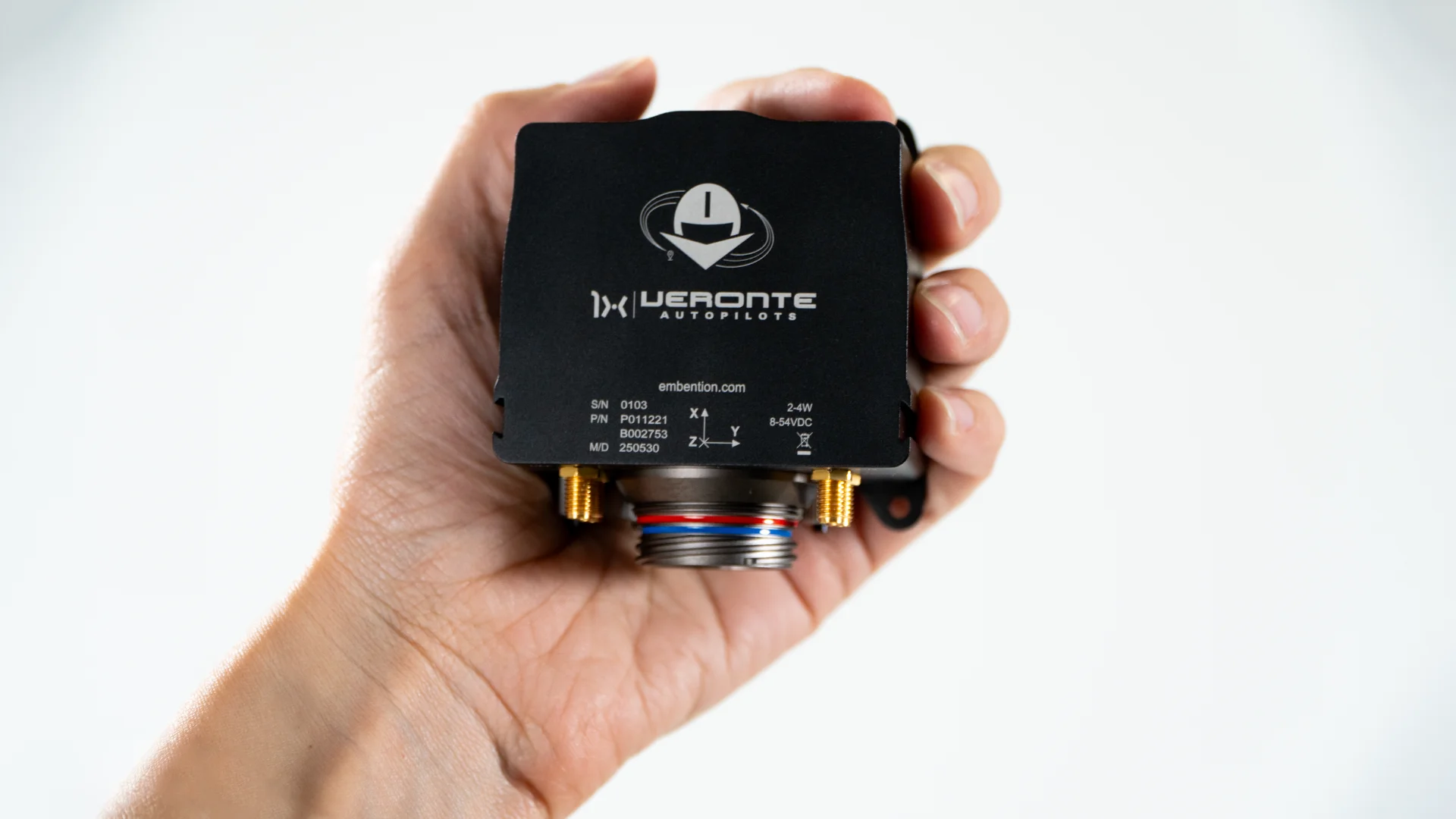
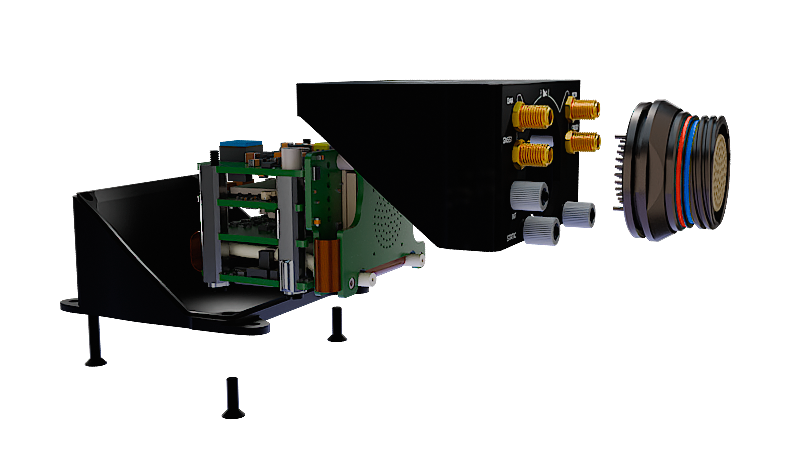
Miniaturized flight control system for drones, eVTOLs, and autonomous vehicles. Developed in accordance with avionics certification standards DO-178C (ED-12), DO-254 (ED-80), and DO-160. It integrates sensors, 4G BLOS communications, and Remote ID / ADS-B

 Any Vehicle
 Model-Based Design
 Certification Datapack
 GNSS Attitude
 Cloud Connectivity


Advanced customization tools give drone integrators full access to tailor autopilot behavior to the aircraft and mission needs. Failsafes, routines, programs, phases, control channels, navigation, and guidance can all be defined and adjusted to fit any operation.

A Simulink-like interface enables users to visually create sophisticated programs for GNC, mission logic, and custom functionalities. Complex control strategies can be developed without extensive coding knowledge.
This intuitive environment accelerates system development and allows rapid iterations, making it easier to adapt the autopilot to new mission profiles or platform configurations, all while maintaining DO178C compliance.

Developers can import custom C++ code into Veronte hardware, enabling the creation of specialized functions tailored to unique project needs.
The Custom Code license enables users to integrate their own modules as program blocks within the autopilot software, offering full flexibility while ensuring seamless compatibility with the core system.

Events and actions can be easily defined to automate flight phases, failsafes, mission sequences, and any other routine, supporting fully autonomous operations.
Triggers such as altitude, speed, location, or system status can activate predefined actions — such as return-to-home or output activation — ensuring safe, reliable, hands-free control across all flight scenarios.
Embention is a pioneer in drone and eVTOL certification, delivering autopilots designed to meet strict aviation standards and providing full supporting evidence for airworthiness certification.

The miniaturized design of Veronte Autopilot concentrates all flight control functions into a lightweight 198 g unit. It features advanced redundant sensors, IMU, GNSS, barometer, among others, integrated in the core hardware. High-performance functions such as RTK differential GNSS and GNSS-based heading estimation are fully embedded within the system.


Agnostic to external peripherals. Supports Serial, CAN Bus, PWM, and more. Custom message tools enable seamless integration with any device.














More than 15 years of drone autopilot development are concentrated in Veronte Autopilot, delivering outstanding features and capabilities.
Enables autonomous takeoff, landing, and flight from moving ground or sea vehicles. Relative missions can be defined so the drone follows the control station on a vessel or vehicle. Combined with Rendezvous algorithms and optional high-precision relative positioning sensors, it enables accurate landings even in GNSS-denied environments.
Interfaces with a gimbal to enable fly-by-camera control. The drone autonomously follows the camera pointing direction, allowing the operator to intuitively guide flight. Configurable to maintain current altitude or adjust vertical movement based on gimbal orientation.
Supports multiple UAVs and control stations operating in a shared network. Enables simultaneous control of multiple drones and formation flights with relative positioning. Also supports seamless drone handover between operators, ensuring maximum flexibility in collaborative missions.
Enables flight along smooth, continuous 3D curves beyond basic waypoint navigation. Allows drones to follow efficient, fluid paths with precise control of speed and orientation throughout the mission. Perfect for applications requiring smooth dynamics, such as mapping, inspection, or surveillaance.
Dual GNSS receivers provide accurate heading and attitude estimation without sole reliance on magnetometers. Reduces sensitivity to electromagnetic interference and enhances flight stability. GNSS data is fused into the extended Kalman filter to improve aircraft attitude and orientation accuracy in challenging environments.
Integrated RTK GNSS provides centimeter-level positioning accuracy without external hardware. Reduces system weight and integration complexity. Ideal for precision agriculture, survey, and other missions requiring high positional accuracy and robust navigation performance.
Allows full customization of flight phases and control modes for any aircraft configuration. Enables smooth, optimized transitions during complex missions with VTOL, tilt-rotor, tilt-wing, or hybrid aircraft. Adaptable for dynamic mission profiles and advanced platform requirements.
Adaptive algorithms dynamically adjust flight control gains during operation. Optimizes performance for missions with changing payloads, such as delivery flights, or variable conditions, like stratospheric operations. Maintains flight stability and responsiveness across all flight phases and environments.
Compatible with internal and external datalink modules: Satcom, Starlink, 4G, MIMO, LOS/BLOS. Allows configuration of redundant communication channels for mission-critical connectivity, ensuring continuous data links across diverse operational scenarios.
Embedded black box records extensive flight data with fully configurable variables and logging frequencies. Supports continuous or event-based logging. Essential for post-mission analysis, compliance, and certification processes, offering full traceability of flight operations.
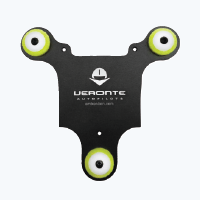
Damping system for Veronte Autopilot 1x 4.8. Aluminum mounting with foam vibration isolation.
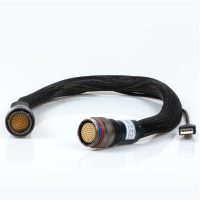
HIL harness for Veronte Autopilot 1x 4.8. Includes I/O and USB PC connection for real vehicle simulation.
| All Vehicles | Plane | Multi | Heli | Autogiro | VTOL | USV | + |
| 100% Autonomous | Mission & payload | Assisted | Manual | Auto |
| Advanced Control | Adaptative | Curve-based | Fly-by-camera |
| Sense & Avoid | Radar | Lidar | Camera | ADS-B | Remote ID |
| All-in-one Box | Sensors | FTS | Comms | ADS-B or Remote ID |
| Internal Sensors | 2x IMU | 2x Magneto | 2x Barómetro | 1x Pitot |
| Positioning | 2x GNSS | RTK | GNSS Heading |
Loading prices...