

View lesson
 5 min
5 minUses, operational models, and the future of eVTOLs
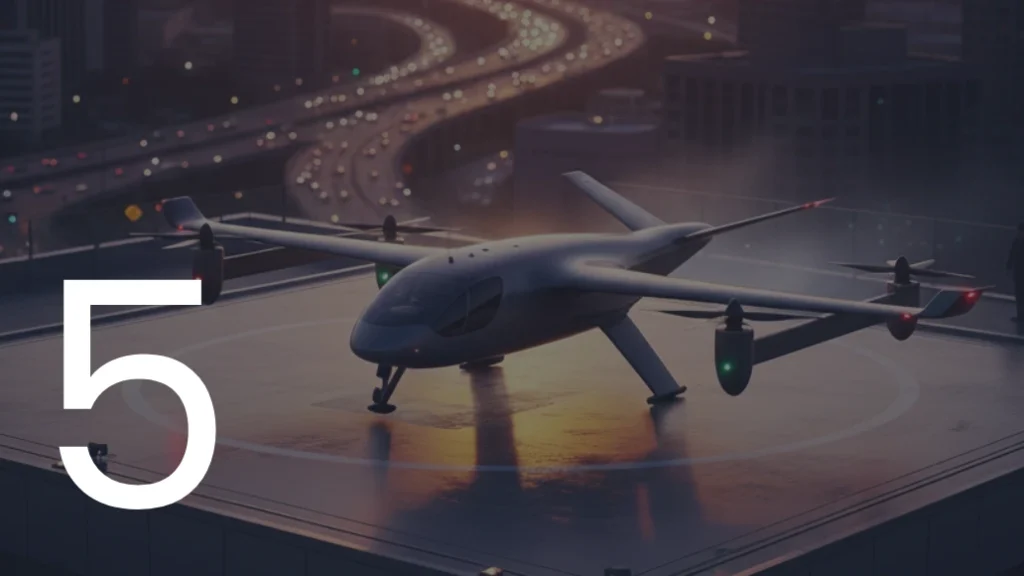

Electric Vertical Take-Off and Landing (eVTOL) aircraft are at the centre of a transportation revolution that could reshape how people and goods move in urban and regional environments. More than just new aircraft, eVTOLs form part of a broader ecosystem (Advanced Air Mobility (AAM)) which integrates infrastructure, traffic management, energy systems, business models and regulatory frameworks to enable safe, efficient, sustainable low-altitude flight.
This lesson explores the present and emerging uses of eVTOLs, the operational models being tested and envisioned, and the future trajectories of AAM, addressing technology, regulation, infrastructure, and societal implications.
Primary uses and use cases
eVTOLs are envisioned to serve a wide range of applications, each with distinct requirements in terms of performance, autonomy, and operations. These can be broadly grouped into the following categories:
Urban air taxi and passenger transport
The most widely cited use case for eVTOLs is urban passenger transport, commonly referred to as air taxis. These services aim to provide fast, point-to-point travel over short to medium distances (e.g., tens of kilometres) above ground traffic. This can significantly reduce travel times in congested metropolitan areas, offering an alternative to ground transport.
Air taxi services typically target missions with distances of 10–50 km and mission durations of 10–30 minutes, connecting points such as airports, business districts, transport hubs and suburbs. Urban air taxi fleets will rely on distributed networks of vertiports—small facilities where aircraft can take off, land, charge and board passengers. Infrastructure planning for vertiports is an active area of regulatory and urban development.
Regional connectivity
Beyond strictly urban travel, eVTOLs can serve regional transport needs, connecting cities or regions that are inefficiently linked by ground transport. This includes short intercity routes where conventional fixed-wing aircraft are suboptimal but ground transport is slow. Such regional missions may require greater range and speed than urban air taxis, influencing aircraft design and energy requirements.
Emergency services and public safety
eVTOLs have the potential to support emergency medical services, disaster response, and search & rescue. Their vertical take-off capability and ability to access remote or congested areas make them suitable for rapid response, critical supply delivery and evacuation missions. Demonstration flights—including emergency air demonstrations in urban settings—highlight how these aircraft could augment emergency logistics and first-responder capabilities.
Cargo, logistics and last-mile delivery
While passenger transport garners much attention, eVTOLs also hold promise for cargo and logistics, particularly for time-sensitive deliveries. AAM frameworks anticipate systems where goods (and even medical supplies) are transported in low-altitude aerial corridors, complementing traditional ground logistics. Concepts encompass both dedicated cargo eVTOLs and mixed passenger/cargo missions, enabling urban freight strategies that bypass ground congestion.
Specialized and emerging applications
Beyond these core cases, eVTOLs could serve additional roles such as tourism and sightseeing flights, infrastructure inspection, communication relay, and military/defence support. Their flexibility in take-off/landing and potential for autonomous operations expand the envelope of aerial services.
Operational models for eVTOL services
Bringing eVTOL use cases to life requires not only aircraft, but coordinated operational models that integrate airspace, infrastructure, service delivery and economic sustainability.
Vertiport-centric service networks
Vertiports are the nodes of eVTOL networks. These facilities are strategically placed to optimize accessibility, safety and connectivity with ground transport. A vertiport network enables multi-node point-to-point aerial routes, much like stations in a rail or bus system, but in three dimensions.
Operators are evaluating vertiport layouts that integrate battery charging, passenger handling, maintenance and air traffic coordination. Vertiport planning includes acoustic zoning, community impact mitigation, and airspace deconfliction protocols.
Pilot-operated and automated operations
Initially, most eVTOL operations will involve pilots onboard to satisfy certification and public acceptance requirements. However, automation and advanced flight control systems will play a major role even in piloted cases, providing envelope protection, navigation assistance and optimized energy management.
Trials of autonomous eVTOL flights—including pilotless urban flights—signal the long-term direction toward automated operations under carefully controlled environments and regulatory oversight.
Traffic management and integration
Low-altitude traffic management is a central operational challenge. eVTOLs must be integrated with existing air traffic management (ATM) and new Unmanned/Urban Traffic Management (UTM/UATM) systems that provide separation, routing, surveillance and communications tailored to dense, dynamic environments.
Intelligent networks combining localized flight data, connectivity services and real-time coordination will be essential to safely scale eVTOL traffic. Emerging research suggests that network slicing and advanced communication architectures could support these needs.
Fleet and energy management
Unlike traditional aviation, eVTOL fleets must consider energy constraints explicitly. Battery capacity, charging infrastructure, idle versus flight energy usage, and throughput influence fleet sizing, scheduling and operational reliability. Simulator-based analyses show that factors such as fleet size and vertiport distance significantly impact delays and energy consumption. Efficient network design must balance performance against operational costs.
Technological and societal drivers of the future
The future of eVTOLs and AAM will be shaped by a combination of technological advances, regulatory evolution and societal acceptance.
Technological innovation
Advances in propulsion, energy storage, controls, autonomy and manufacturing are central to expanding eVTOL capabilities. Higher energy density batteries, more efficient electric motors and lightweight structures will extend range, increase payload and reduce operating cost. Research on autonomous flight and sensor fusion promises to support higher automation levels and safer operations.
Regulatory evolution
Governments and aviation authorities are moving toward frameworks that support initial piloted operations and pave the way for autonomous systems. Delivery models under discussion emphasize collaboration across regulators, government agencies and private stakeholders to build scalable, safe rule sets for commercial eVTOL deployment.
Aviación Civil del Reino Unido
Public acceptance and sustainability
Noise, safety perception, environmental impact and integration with urban communities are key social factors. eVTOLs are expected to be quieter and more environmentally friendly than helicopters and ground vehicles, supporting sustainability goals. Public acceptance will depend on transparent safety assurance, community engagement, and evidence of real benefits such as reduced congestion and emissions.
The Horizon: Where eVTOLs are headed
Near-term (2025–2030)
In the next decade, commercial air taxi and limited regional services are expected to begin in major urban centres and regional hubs. Several cities have launched pilot programs and commercial agreements to support eVTOL services, including exclusive operating partnerships and early fleet deployments.
These early services will focus on safe, piloted operations, supported by phased regulatory approval and dedicated infrastructure. They will provide key data and operational experience that inform broader scaling.
Mid-term (2030–2040)
As operations mature, advanced vertiport networks, automated traffic management and higher levels of automation could expand usage. Increased range and performance will support intercity eVTOL services and enhanced cargo/logistics models.
Integration with broader multimodal transport ecosystems—linking aerial services with rail, road and micro-mobility—will define integrated mobility strategies.
Long-term (Beyond 2040)
Looking further ahead, autonomous flight, high-density low-altitude corridors and fully optimized AAM networks could reshape transportation as fundamentally as commercial aviation did in the 20th century. Concepts include fully autonomous fleets, regional aerial corridors, and dynamic energy/air traffic systems that support massive scaling.
Summary
eVTOLs are poised to transform how people and goods move across urban and regional landscapes. From urban air taxis and emergency response to logistics and regional air mobility, these aircraft will integrate into broader multimodal transport ecosystems.
Real-world operations will be enabled by vertiports, traffic management systems, fleet and energy planning, and evolving regulatory frameworks. Technological innovation and societal acceptance will further shape how quickly and widely eVTOLs enter service.
The future of eVTOL and AAM promises cleaner, faster, more flexible transport—bringing aviation closer to everyday life and addressing key mobility challenges of the 21st century.
