

View lesson
 5 min
5 minThe future of drones and unmanned systems
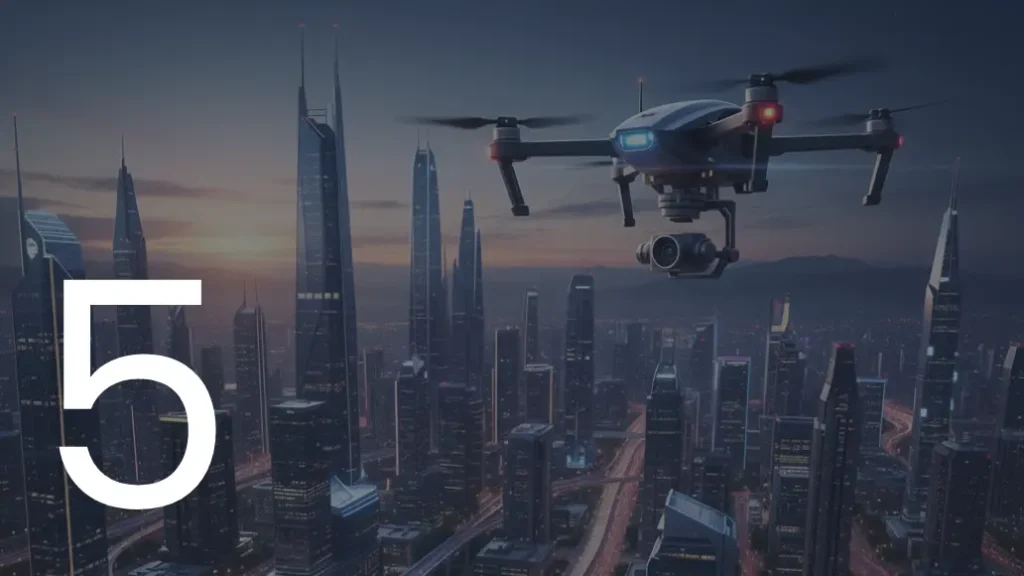

The drone and unmanned systems sector is currently undergoing a strategic transition. After an initial phase focused on technological adoption and validation of use cases, the immediate future will be defined by the safe and scalable integration of these systems into complex environments, particularly shared airspace alongside manned aviation and in missions that are critical to society.
This lesson examines the main evolutionary drivers of the UAV ecosystem, addressing technological, regulatory, operational, and societal aspects. Understanding these trends is essential for engineers, operators, and system architects who aim to design sustainable, certifiable solutions aligned with the future framework of aviation and autonomous systems.
Evolution toward higher levels of autonomy
One of the most significant drivers shaping the future of drones is the progressive increase in operational autonomy. While current systems still rely heavily on human supervision, future drones will be designed to plan, execute, and adapt missions autonomously, within clearly defined safety boundaries.
This autonomy extends beyond following preprogrammed routes and includes capabilities such as detect-and-avoid, dynamic mission reconfiguration, multi-sensor decision-making, and automated fault management. The development of advanced control, perception, and reasoning algorithms will be fundamental to achieving these levels of autonomy.
At the same time, higher autonomy will impose stricter requirements for verification, validation, and certification, as systems must demonstrate predictable and safe behavior even in non-nominal or unexpected scenarios.
Airspace integration and unmanned traffic management
The future of drones is closely linked to their safe integration into shared airspace. As the number of operations increases, particularly beyond visual line of sight (BVLOS), robust Unmanned Traffic Management (UTM) systems will become essential.
UTM frameworks will enable coordination between multiple drones operated by different stakeholders, ensuring safe separation, dynamic airspace management, and interoperability with manned air traffic systems. Standardization and cooperation between platforms, regulators, and service providers will be critical to the success of this ecosystem.
From a technical perspective, future drones must incorporate advanced capabilities for remote identification, standardized communications, and situational awareness, requiring close collaboration across the industry.
Certification, standardization, and regulatory maturity
Unlike the early stages of drone adoption, the future of unmanned aviation will be characterized by increased regulatory maturity. Certification frameworks will evolve toward clearer and more harmonized models that combine traditional aviation standards with risk-based approaches.
The adoption of methodologies such as SORA and the definition of integrity and assurance levels will enable the progressive scaling of complex operations. In parallel, demand for certifiable systems will grow, particularly for safety-critical commercial applications such as logistics, infrastructure monitoring, public services, and, in some cases, passenger transport.
As a result, UAV and system design will increasingly be driven by a certification-oriented mindset, integrating software, hardware, and system assurance standards from the earliest stages of development.
New operational and economic models
The future of drones is not limited to technological progress; it also involves the emergence of new operational and business models. Instead of isolated, ad-hoc missions, the industry will move toward continuous, scalable services embedded within industrial, logistical, and urban processes.
Examples include drone-as-a-service models, cooperative drone networks, automated periodic inspection operations, and persistent surveillance systems. Operational efficiency, cost optimization, and seamless integration with existing digital infrastructures will be decisive factors for widespread adoption.
In parallel, lifecycle management, from design and certification through maintenance, operation, and decommissioning, will play an increasingly important role in professional unmanned system deployments.
Advances in sensors, communications, and processing
Progress in sensor technologies, communications, and onboard processing will be another cornerstone of the future of drones. Increased integration of multimodal sensors will enable systems to combine visual, thermal, acoustic, and electromagnetic data, resulting in richer and more reliable situational awareness.
In the communications domain, advanced networks will provide more robust links with lower latency and higher bandwidth, supporting complex and safety-critical operations. These capabilities will be essential for real-time data transmission and coordination between multiple platforms.
Data processing architectures will increasingly distribute computation between the drone and external systems, combining onboard processing with ground-based or cloud infrastructures. This hybrid approach will reduce latency for critical decisions while enabling efficient analysis of large data volumes.
Cooperative operations and swarm systems
Another key trend is the evolution toward cooperative operations, in which multiple drones work together to accomplish a shared mission. Often referred to as swarm systems, these configurations increase coverage, redundancy, and operational efficiency.
Technically, swarm operations require advanced coordination algorithms, reliable inter-vehicle communications, and distributed task management mechanisms. While they pose significant challenges in terms of safety assurance, certification, and control, they also offer substantial potential in applications such as surveillance, mapping, emergency response, and defense.
Social, ethical, and environmental impact
The future of drones will also be shaped by their social and ethical impact. As unmanned systems become part of everyday life, issues related to privacy, public acceptance, noise, safety, and responsible data use must be carefully addressed.
Environmental sustainability will likewise be a key consideration. Designing more energy-efficient drones, minimizing operational environmental impact, and adopting responsible resource management practices will increasingly influence both technical and regulatory decisions.
Public trust in unmanned systems will depend largely on transparency, demonstrated safety, and adherence to clear ethical principles.
Lesson and course conclusion
The future of drones is defined by the convergence of advanced autonomy, airspace integration, robust certification, and new operational models. Far from being an isolated emerging technology, unmanned systems are poised to become a core infrastructure supporting multiple sectors of society.
For professionals in the field, the challenge is not only to develop advanced technology, but to do so in a manner that is safe, certifiable, scalable, and socially acceptable. Understanding these trends is essential for anticipating industry evolution and actively contributing to the responsible growth of unmanned systems.
This lesson concludes the course, providing a comprehensive perspective that connects technical fundamentals, platform types, regulatory frameworks, current applications, and the future trajectory of drones and unmanned vehicles.
