

View lesson
 5 min
5 minWhat is a drone, and how is it used?
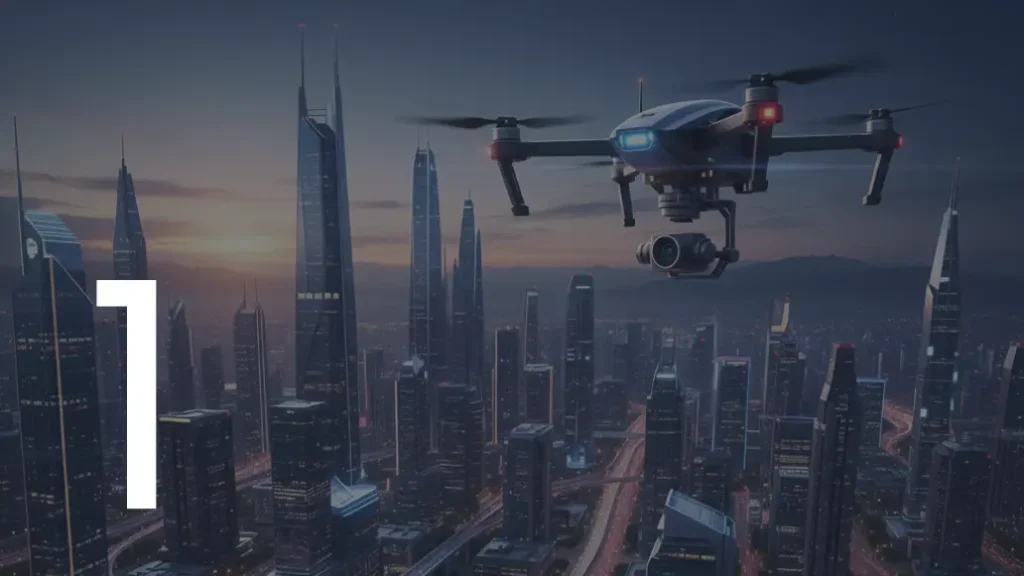

Definition of drone
A drone, technically referred to as an Unmanned Aerial Vehicle (UAV), is an aircraft designed to operate without a human pilot on board. It can be controlled remotely by an operator from a ground control station or operate in a fully or partially autonomous manner using satellite navigation systems, sensors, onboard processing units, and flight control algorithms. These systems allow the drone to execute preprogrammed trajectories, maintain flight stability, and respond to environmental changes without continuous human intervention. The integration of critical control systems makes drones highly versatile tools for professional and industrial applications.
From an operational standpoint, drones can perform missions ranging from precise stationary flight to long-range automated operations, depending on their airframe design, propulsion system, and autonomy level. Their ability to carry specialized payloads, such as high-resolution cameras, sensors, thermal imaging systems, or communication equipment, is what differentiates professional drones from recreational platforms. Furthermore, their operation is subject to aviation regulations that ensure safety, reliability, and efficient integration into shared airspace.
Types of drones: architecture and characteristics
Drones can be classified according to several criteria, but one of the most relevant for professional applications is their structural and aerodynamic configuration. Each type offers specific technical advantages that make it suitable for particular mission profiles.
The multirotor drone is the most widely recognized and commonly used configuration. It consists of multiple motors and propellers that generate vertical lift. Its ability to take off and land vertically without the need for a runway, as well as to maintain a stable hover, makes it ideal for detailed inspections, aerial photography, and operations in confined or complex environments. Although its flight endurance is generally lower than that of fixed-wing aircraft, its precise attitude control and positional accuracy make it the dominant solution for close-range inspection and imaging tasks.
The fixed-wing drone resembles a conventional airplane in its aerodynamic design. It generates lift through its wings, enabling it to cover long distances with high energy efficiency and significantly greater endurance. However, it requires space for takeoff and landing and cannot hover in place. These characteristics make fixed-wing UAVs especially suitable for large-area mapping, territorial surveillance, and long-range reconnaissance missions.
A hybrid or VTOL (Vertical Take-Off and Landing) drone combines the advantages of multirotor and fixed-wing platforms. It can take off and land vertically like a multirotor while transitioning to efficient forward flight like a fixed-wing aircraft. This configuration provides extended range and endurance without sacrificing operational flexibility in areas where runways are unavailable.
Less conventional platforms include the blimp, or unmanned airship, which relies on lighter-than-air gas for lift rather than aerodynamic surfaces. This type of drone is particularly suited for persistent, low-speed observation missions, such as border monitoring or long-duration environmental surveillance.
Gyrocopters and unmanned helicopters represent rotary-wing configurations inspired by manned aviation. These platforms are capable of hovering while carrying heavier payloads than typical multirotors and maintaining stable flight in challenging wind conditions. As a result, they are often used in missions requiring higher payload capacity and endurance.
The parafoil drone uses an inflatable wing similar to a paraglider to generate lift. Its flight profile and aerodynamic efficiency make it suitable for long-distance transport of lightweight payloads with reduced energy consumption.
Other specialized categories include target drones, which are designed to act as aerial targets for defense training or testing of counter-drone systems. In addition, the concept of unmanned systems extends beyond aerial platforms to include UGVs (Unmanned Ground Vehicles) and USVs (Unmanned Surface Vehicles), which operate on land and water respectively, broadening the scope of unmanned vehicle technology.
Professional applications of drones
The adoption of drones in professional environments has transformed numerous industries due to their ability to collect high-quality data, automate inspections, reduce human risk, and lower operational costs. The following sections describe the most relevant application domains, taking into account different UAV platforms and their operational capabilities.
In the field of audiovisual production and cinematography, multirotor drones equipped with high-resolution cameras and advanced stabilization systems enable the capture of complex aerial imagery that previously required cranes, manned helicopters, or cable-based systems. This has significantly expanded creative possibilities while reducing production costs and logistical complexity.
Precision agriculture has benefited extensively from UAV technology. Drones equipped with multispectral sensors and specialized cameras can fly over large agricultural areas to measure vegetation indices, assess crop health, detect water stress, and identify pest infestations at early stages. This data-driven approach allows agronomists to optimize irrigation, fertilization, and crop management practices, increasing productivity while minimizing environmental impact.
In surveying, cartography, and geospatial modeling, drones have replaced or complemented traditional data acquisition methods through the use of photogrammetry and LiDAR sensors. Fixed-wing and hybrid UAVs are particularly effective for covering large areas and collecting georeferenced data, which can then be processed to generate digital terrain models (DTMs) and high-accuracy three-dimensional maps. These capabilities are widely used in civil engineering, urban planning, mining, and environmental impact assessments.
The use of drones in security, emergency response, and civil protection has become increasingly important. UAVs equipped with thermal cameras, night-vision systems, and real-time data links provide immediate situational awareness in search-and-rescue operations, wildfire monitoring, disaster response, and law enforcement support. Their ability to operate in hazardous or inaccessible environments significantly reduces risk to personnel while improving decision-making through real-time aerial information.
In industrial sectors such as critical infrastructure inspection, drones have become a standard tool. Multirotor and unmanned helicopter platforms are used to inspect power lines, substations, wind turbines, bridges, and oil and gas facilities. These inspections can be carried out more quickly and safely than traditional methods, reducing downtime and minimizing the exposure of workers to hazardous conditions.
Finally, logistics and transportation represent an emerging application area for UAVs. Fixed-wing and hybrid drones are being developed to support light cargo delivery, particularly in remote or hard-to-reach locations. Although these operations are subject to strict regulatory frameworks, they offer significant potential for medical supply transport, emergency logistics, and automated last-mile delivery.
Conclusion
Drones have evolved from experimental or recreational devices into essential professional tools across a wide range of industries. Their technical classification, from multirotor and fixed-wing platforms to hybrid and specialized unmanned systems. directly reflects specific operational requirements, each with distinct aerodynamic and mission-performance characteristics. At the same time, their professional applications are reshaping practices in agriculture, engineering, security, audiovisual production, cartography, and logistics. A thorough understanding of UAV types and their appropriate use cases is fundamental for designing, operating, and managing drone missions effectively, while maintaining high standards of safety, reliability, and regulatory compliance.
