

View lesson
 5 min
5 minCritical systems of eVTOL aircraft
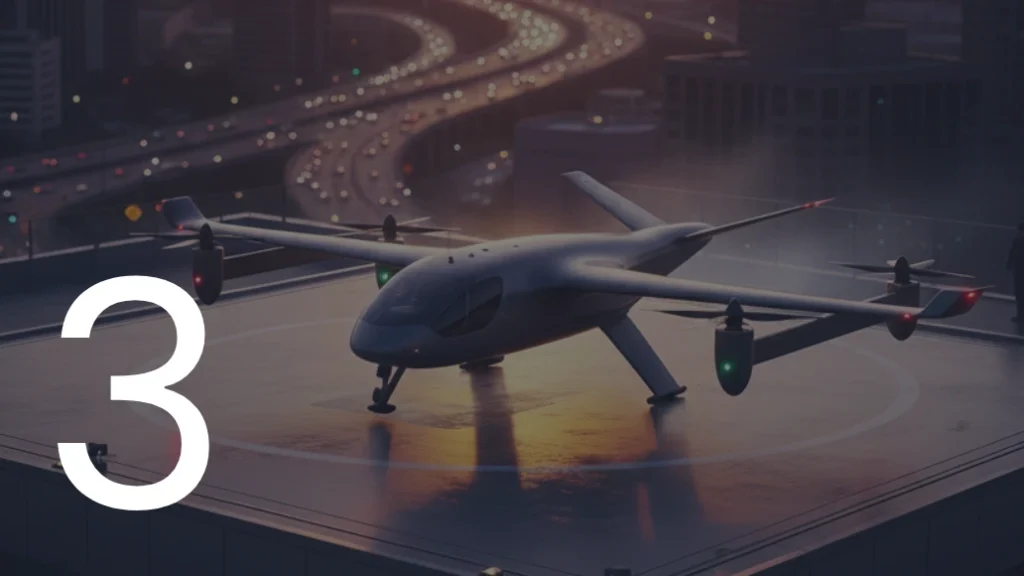

The performance, safety, and certifiability of an eVTOL aircraft are determined not only by its overall architecture, but by the design and integration of a set of safety-critical subsystems. Unlike conventional aircraft, eVTOLs rely extensively on electrical power, software-driven control, and distributed architectures, making system integration and functional safety central design challenges.
This lesson examines the core systems of an eVTOL aircraft, focusing on propulsion, energy, flight control, avionics, communications, and redundancy management. Each of these systems must be engineered to meet extremely high safety and reliability requirements, particularly for passenger-carrying operations in urban environments.
Electric propulsion system
At the heart of every eVTOL lies its electric propulsion system. This system typically consists of multiple electric motors, inverters (motor controllers), propellers or rotors, and associated control electronics.
Electric motors offer several advantages over combustion engines, including high efficiency, fast dynamic response, and reduced mechanical complexity. In eVTOLs, propulsion is usually distributed, meaning that lift and thrust are generated by multiple independent propulsors rather than a single central unit.
From a safety perspective, distributed propulsion enables graceful degradation. The aircraft can be designed to tolerate the loss of one or more motors without catastrophic consequences, provided that the remaining propulsors and control systems can compensate.
However, this architecture introduces challenges in terms of synchronization, fault detection, and thermal management. Each motor and inverter becomes a potential failure point, and the propulsion system as a whole must demonstrate predictable behavior under both nominal and degraded conditions.
Certification authorities pay particular attention to propulsion system failure modes, especially in hover and transition phases, where margins are limited and pilot workload may be high.
Energy storage and power management
The energy system is one of the most critical and constraining elements of an eVTOL. Most current designs rely on high-energy-density lithium-based batteries, which must deliver sufficient power for vertical flight while maintaining acceptable weight and thermal margins.
Energy system design encompasses not only the batteries themselves, but also the Battery Management System (BMS), power distribution units, contactors, and cooling systems. The BMS is responsible for monitoring cell voltage, temperature, and state of charge, as well as protecting the battery from unsafe operating conditions.
Thermal management is particularly challenging, as batteries must operate within narrow temperature ranges to ensure performance, longevity, and safety. Rapid power draw during take-off and landing, combined with regenerative or high-load cruise phases, requires carefully engineered cooling strategies.
From a certification standpoint, energy systems must demonstrate containment of failures, especially thermal runaway scenarios. Authorities require evidence that battery failures will not propagate uncontrollably or compromise other critical systems.
Flight control system
The Flight Control System is arguably the most safety-critical subsystem in an eVTOL aircraft. It is responsible for maintaining aircraft stability, controlling attitude and trajectory, managing transitions between flight modes, and assisting or protecting the pilot throughout the flight envelope.
eVTOLs rely on fly-by-wire control architectures, where pilot inputs are interpreted by computers rather than mechanically transmitted to control surfaces. This enables advanced control laws, envelope protection, and automated functions that are essential for managing complex propulsion configurations.
In many eVTOL architectures, the FCS must coordinate dozens of actuators simultaneously, including motor speeds, tilt mechanisms, control surfaces, and energy limits. This level of coupling requires sophisticated control algorithms and extensive validation.
Given its criticality, the FCS typically targets the highest Design Assurance Levels. This implies strict requirements on software development (DO-178C), hardware design (DO-254), and system verification.
Sensors and state estimation
Reliable control depends on accurate and robust sensor data. eVTOLs integrate a wide range of sensors to measure aircraft state, including inertial measurement units (IMUs), air data sensors, GNSS receivers, magnetometers, and propulsion feedback sensors.
These sensors feed into state estimation algorithms, which combine multiple data sources to produce reliable estimates of attitude, position, velocity, and system health. Sensor fusion is particularly important in urban environments, where GNSS signals may be degraded or unreliable.
Redundancy and diversity are key design principles in sensor systems. Multiple independent sensor chains, often using different technologies, are used to mitigate common-mode failures and increase confidence in the estimated state.
Certification authorities evaluate not only sensor accuracy, but also failure detection, cross-checking mechanisms, and the system’s ability to maintain safe operation in the presence of faulty data.
Avionics and mission management
The avionics system provides the interface between the aircraft, the pilot, and external systems. This includes displays, input devices, navigation systems, mission management functions, and alerting systems.
In eVTOLs, avionics are designed to reduce pilot workload, particularly during high-demand phases such as vertical take-off, landing, and transition. Automated checklists, decision support tools, and intuitive human–machine interfaces are essential to safe operation.
Mission management functions may include route planning, energy monitoring, performance prediction, and contingency management. These functions become increasingly important as operations scale and automation levels increase.
From a certification perspective, avionics must demonstrate clear, unambiguous information presentation and effective alerting, ensuring that pilots can make timely and correct decisions under both normal and abnormal conditions.
Communications and data links
Reliable communications are essential for eVTOL operations, particularly in dense airspace and urban environments. Data links support voice and data communication with air traffic services, operators, and fleet management systems.
Future eVTOL operations are expected to rely heavily on digital communications, including vehicle-to-infrastructure and vehicle-to-vehicle links. These enable traffic coordination, situational awareness, and integration with Unmanned Traffic Management (UTM) and conventional ATM systems.
Communications systems must be designed with appropriate redundancy, latency control, and cybersecurity protections, as loss or corruption of communication can have serious safety implications.
Redundancy and fault management
Redundancy is a defining feature of eVTOL system design. Given the safety expectations associated with passenger transport, eVTOLs must demonstrate tolerance to a wide range of failures without loss of control.
Redundancy can be implemented at multiple levels: hardware, software, power supply, sensors, and even functional redundancy across systems. However, redundancy alone is not sufficient; systems must include robust fault detection, isolation, and recovery mechanisms.
System integration and certification implications
The integration of all these subsystems into a coherent aircraft-level system is one of the greatest challenges in eVTOL development. Interactions between propulsion, energy, control, and avionics systems can create complex dependencies that must be carefully analyzed and tested.
From a certification standpoint, authorities evaluate not only individual subsystems, but also system-level behavior, including failure cascades, pilot interaction, and overall operational safety.
Successful eVTOL programs adopt a systems engineering approach, with clear requirements, traceability, and verification at every level of the design.
Conclusion
eVTOL aircraft rely on a tightly integrated set of safety-critical systems, each of which must meet demanding performance and reliability requirements. Electric propulsion, energy storage, flight control, avionics, communications, and redundancy management are all fundamental to enabling safe and scalable eVTOL operations.
Understanding these systems and their interactions is essential for anyone involved in the design, certification, or operation of eVTOL aircraft. In Lesson 4, the focus will shift to certification, regulation, and operational frameworks, examining how these complex systems are approved for real-world use and integrated into the aviation ecosystem.
