

View lesson
Course content
 7 min
7 minLoitering Munitions: understanding the “Kamikaze” drones
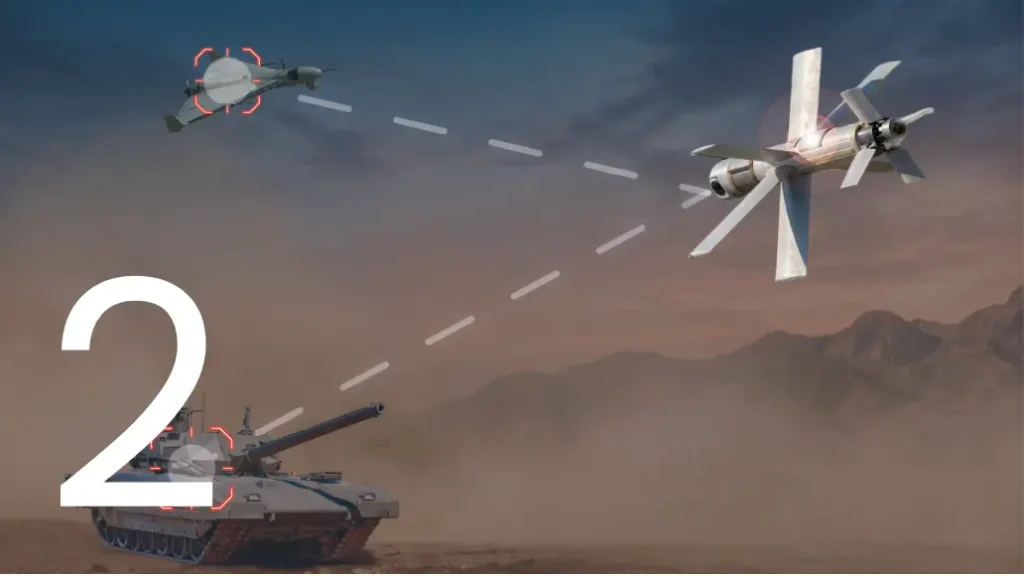

In Lesson 1, we established the paradigm shift from reusable aircraft to expendable systems. Now, we will focus our engineering lens on the most strategically disruptive category within this space: Loitering Munitions (LMs).
While mainstream media frequently uses the sensationalist term “kamikaze drones,” as aerospace professionals, we must understand these platforms as highly sophisticated, autonomous, precision-guided aerial systems. They represent a fascinating bridge between traditional artillery, cruise missiles, and Unmanned Aerial Vehicles (UAVs). In this lesson, we will dissect their anatomy, analyze their unique flight profiles, and explore the critical avionics that make them so effective on the modern battlefield.
Defining the loitering munition: Missile vs UAV
To truly grasp the engineering behind a loitering munition, it is helpful to compare it to a traditional cruise missile.
When a traditional cruise missile is launched, its target coordinates must be known in advance. The missile flies a pre-programmed path using GPS and inertial navigation, strikes the coordinate, and detonates. It is highly effective against static infrastructure, but it possesses limited flexibility. If the target moves while the missile is in transit, or if the initial intelligence was wrong, the missile cannot easily change its mission.
A loitering munition solves this tactical rigidity. It is launched into an area of interest without needing a precise target coordinate. Once it arrives in the designated zone, it transitions into a “loiter” phase, circling the area for minutes or even hours. During this phase, it acts as an Intelligence, Surveillance, and Reconnaissance (ISR) UAV, using its onboard cameras and sensors to scan the ground below. Only when a high-value target is positively identified does it transition into an attack profile, diving down to deliver its explosive payload.
Essentially, a loitering munition is a smart missile with the endurance and observation capabilities of a drone, granting commanders unprecedented tactical patience.
The anatomy of a Loitering Munition
Designing a loitering munition requires balancing competing aeronautical requirements. Let’s break down the core hardware components that make up these systems:
The airframe and aerodynamics
The aerodynamic design of an LM is a study in compromise. The aircraft must excel at two entirely different flight regimes:
- The loiter phase: the airframe needs high aerodynamic efficiency (a high lift-to-drag ratio) to stay airborne as long as possible using minimal energy. This often favors long, straight wings or delta-wing configurations that maximize lift at lower cruising speeds.
- The terminal dive: Conversely, when the drone identifies a target, it must dive at high speeds to minimize the time the enemy has to react or deploy countermeasures. High speed requires low drag and the structural integrity to withstand high G-forces.
Many modern LMs utilize foldable wings. They are launched from a compact pneumatic tube; once clear of the tube, the wings snap into place for the efficient loiter phase.
Propulsion systems
The choice of propulsion dictates the drone’s acoustic signature, speed, and endurance.
- Electric motors: most tactical, man-portable LMs use electric propulsion. Electric motors are incredibly reliable, mechanically simple, and, most importantly, possess a very low acoustic and thermal signature. They are quiet and difficult for infrared sensors to detect, allowing them to sneak up on targets. However, batteries limit their loiter time.
- Internal combustion engines (ICE): larger LMs designed to strike deep behind enemy lines rely on small gasoline or heavy-fuel engines. These provide significantly longer range and endurance (sometimes several hours) but are louder and easier for enemy air defenses to track.
The payload (warhead and sensors)
Because the platform does not need landing gear, a massive percentage of its weight is dedicated to the payload.
- The sensors: LMs are equipped with Electro-Optical (EO) and Infrared (IR) cameras mounted on a stabilized gimbal. These allow the drone to see clearly in daylight or pitch-black conditions.
- The warhead: the explosive charge is integrated directly into the fuselage. Depending on the mission, the warhead can be high-explosive anti-tank (HEAT) to penetrate armored vehicles, or fragmentation to target exposed personnel and radar installations.
The flight profile and the role of the Autopilot
The true “brain” of the loitering munition is its autopilot and flight control system (FCS). In reusable drones, an autopilot manages takeoff, waypoints, and landing. In a one-way LM, the autopilot must execute a highly dynamic and aggressive flight profile with zero margin for error.
Let’s look at the standard flight profile of an LM and how the avionics manage it:
- Launch and climb: the LM is launched (via catapult, pneumatic tube, or rocket booster). The autopilot instantly stabilizes the airframe, corrects any launch anomalies, and aggressively climbs to its cruising altitude.
- Transit and loiter: the drone navigates to the target zone using GPS and Inertial Measurement Units (IMUs). Once there, the autopilot switches to loiter mode, flying efficient circular or figure-eight patterns to conserve energy while keeping the camera gimbal pointed steadily at the ground.
- Target acquisition (Man-in-the-Loop vs. Autonomy): the drone streams live video back to the operator via an encrypted radio data link. The operator scans the feed, identifies the target, and “locks on.” This is known as the “Man-in-the-Loop” (MITL) concept, ensuring a human makes the final lethal decision to prevent collateral damage.
- The terminal dive: once locked, the operator commands the strike. This is where the autopilot proves its worth. The FCS pitches the nose down, increases the throttle to maximum, and executes a high-speed dive. The autopilot must continuously calculate the trajectory, adjusting the control surfaces micro-seconds at a time to keep the target perfectly centered in the crosshairs, compensating for wind shear and the target’s movement until the moment of impact.
The engineering challenge: denied environments and VBN
One of the greatest engineering challenges in modern loitering munition design is operating in “denied environments.” When flying against a sophisticated adversary, operators must assume two things will happen:
- GPS will be jammed or spoofed.
- Radio communication links will be blocked (Electronic Warfare).
If a traditional drone loses GPS and its radio link to the pilot, it is usually programmed to return home or land. A loitering munition, however, must complete its mission.
This is where advanced avionics, such as Visual Based Navigation (VBN) and edge-computing AI, become critical. If an LM loses GPS, its autopilot can use downward-facing cameras to compare the ground below with pre-loaded satellite maps, navigating purely by sight (Odometry and Terrain Referencing).
Furthermore, if the radio link is jammed and the human operator cannot send the final “strike” command, modern LMs are being equipped with AI target recognition. The onboard computer is trained to recognize the silhouettes of enemy tanks, radar dishes, or artillery. Once the AI identifies a valid target, the autopilot can autonomously initiate the terminal dive and lock onto the visual signature, adjusting its flight path purely through image processing without needing GPS or a human pilot. This autonomous terminal guidance is what makes next-generation loitering munitions nearly impossible to stop once they are in the air.
In conclusion, a Loitering Munition is a masterpiece of disposable engineering. It combines the aerodynamic endurance of a surveillance drone with the kinetic power of a missile, all managed by industrial-grade autopilots capable of making microsecond adjustments in the harshest, most electronically noisy environments on the planet.
