

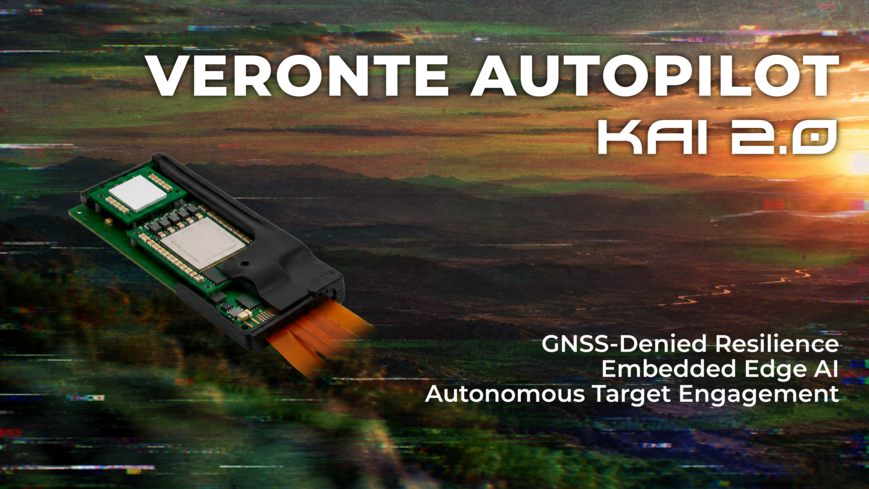
Embention releases upgraded Veronte KAI FCC for One-Way drones at MSPO
Discover Veronte KAI 2.2 with AI-based PNT, terminal guidance and scalable production for one-way drones in contested environments.
February 5, 2016
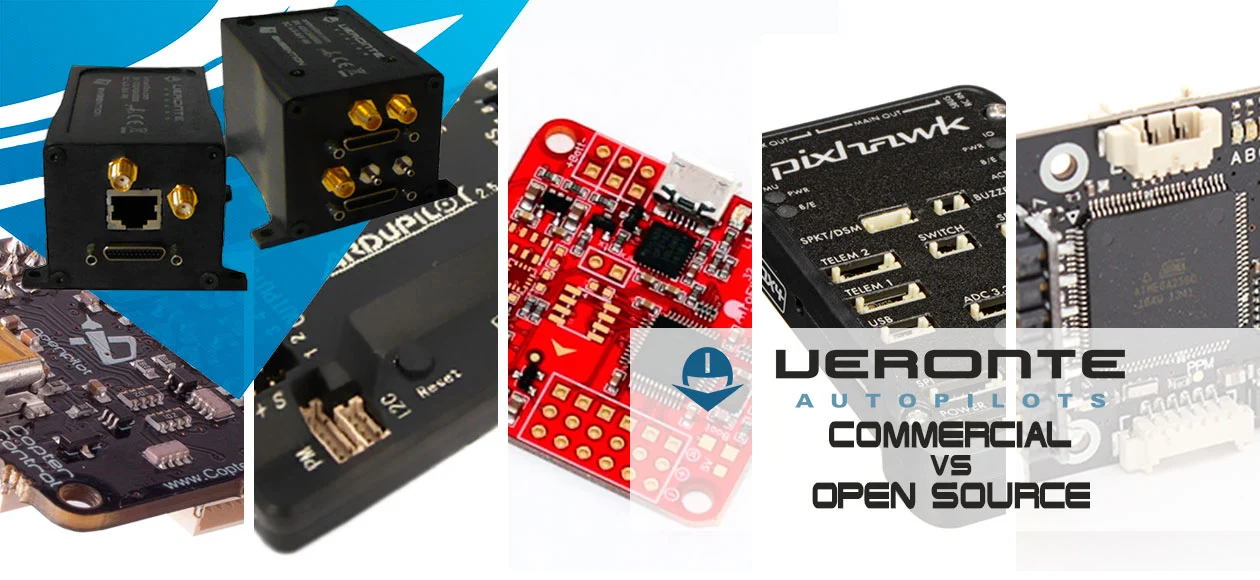
When developing projects with drones, there is always a question that we must face. We must decide between using professional commercial autopilots or hobby/oopen source alternatives. Is it worthwhile investing in commercial autopilots? If this question or similar ones are on your mind, the advantages described in this article will help you clarify.
The development of open-source autopilots tends to focus on the most common drones in the hobby segment. So, when it comes to adapting it to any other model, open source alternatives are highly limited as for the information available and for the code itself.
However, companies that develop commercial autopilots permit them to adapt their products to all kinds of platforms and payloads (cameras, sensors, mechanisms, safety systems, etc.).
In contrast to the open source autopilots, commercial autopilots provide greater safety, employing electronic components and professional manufacturing methods. Including also safety key elements such as double and even triple redundancy. These high reliability components ensure a significantly higher MTBF (Mean Time Between Failure), and component availability for a long period of time.
Certification is a key factor in this aspect that accredits the reliability of commercial autopilots, some of them being certified under DO-178/EED-12 and DO-254. Furthermore, developers have extensive technical documentation and offer support for system certification with the authorities.
Normally, unlike commercial autopilots, open-source alternatives don’t usually have efficient customer support. One of the parts where they often reduce costs is in human resources on the support team, and they also don’t have a system to keep track of their customers.
Actually, many of the open-source alternatives don’t have a support team. Therefore, their customers have to refer to various online forums to get help. With the big drawback that any technical problem or company trade secrets are made public to their customers and competition,.
In this line, commercial systems offer a professional and customized technical service, studying each specific case and helping the client to achieve their objectives in the most efficient manner possible.
Companies developing commercial autopilots normally offer training courses for both system integration and operation. By providing to the customer an extensive knowledge of the autopilot, that permits them to take full advantage of the platform while the confidentiality of critical customer information is maintained.
It is common for UAV companies not to have a technical staff specialized in software, essential for performing the customization of open source systems. This staff is an extra cost to the company, which also shifts its attention from their core business. Commercial autopilot companies have a professional support team to offer customized support throughout all the integration, maximizing the integration of equipment and system functionalities.
Due to the nature of companies that develop open source alternatives, in the long run, these tend to stop the development of their autopilots due to a lack of funds, time, interest, or because their developers are employed by other companies. After this happens, customers are forced to change their autopilot with the consequential loss in investment, time, components, etc., or to renounce system upgrades according to fast technological advances, condemning their products to obsolescence.
This doesn’t happen with companies that develop commercial autopilots, because they focus their development activity on these systems and also boast extensive experience and knowledge of the sector. Constantly adapting the new developments and technology to the latest market trends.
Usually, open source, hobby, and RC autopilot companies limit their investment and their activity to the development of the autopilot, leaving aside other essential investments in the professional sector. Some of these developments are: simulation tools, calibration systems, system reliability, integration of external devices,…
Likewise, the developments in commercial autopilots offer a wide variety of advanced functionalities, not available in basic equipment, such as: curve-based navigation, RTK precision, automatic control of payloads, system automatization, compatibility with hybrid systems, configurable flight phases for each system, sense & avoid, obstacles and safe flight zones definition, video integration within the navigation,…
In business world the time is money, and more in an industry such as the UAVs, which rises by leaps and bounds. The developers of commercial autopilots are able to supply their products efficiently and in a short time. Also, the integration of these systems is typically performed in less than a week. Thus the UAVs manufacturer can have its system flying and fully configured for operation in just a few days, while open source systems usually require several months to render the system ready.
Open source systems and systems focused on hobbies limit their functionality to the performance of basic missions, with the capacity to integrate payloads and external equipment very limited. Differently, the commercial autopilot companies focus their business line on the market needs, adapting to the needs of manufacturers and operators.
Commercial autopilots integrate a wide variety of communication ports: Ethernet, Serial, Can, Arinc,… permitting to make it compatible with a wide range of equipment in order to meet the needs of the most demanding projects.
An essential piece of equipment in these devices is the communication radio. Open-source autopilots normally are limited to the use of WIFI networks or low-range radios for transmitting telecommands and telemetry data. However, professional systems opt for greater versatility.
Commercial autopilots typically provide a powerful communications system, being easily able to reach up to 90 km range in line of sight. Also, many of these systems incorporate other means for establishing communications with the drone, such as satellite communications with global coverage or communications through 3G or 4G networks.
Commercial control systems are developed according to real needs in all kinds of environments. In this way, one of the remarkable functionalities of these systems beyond the open source autopilot limitations is the capability to control multiple drones simultaneously from a single control station, either with one or multiple screens.
Similarly, these systems permit to simultaneously monitor the operation from several control stations, permitting to control and monitor the flight from different locations, either for redundancy reasons or for necessities of the operation.
In conclusion, there are many drone manufacturers who opt for an open source autopilot and in the long run they get overwhelmed by their limitations, being forced to resort to professional systems, thus suffering significant losses in both economic and time. Whereas, opting for an existing commercial Autopilot, such as the Veronte Autopilot 1x, can save costs in the medium and long term, obtaining in addition a system which permits to take full advantage from the platform: High precision RTK positioning, greater radio scope, simultaneous flight capabilities,…

Receive news & updates
Discover Veronte KAI 2.2 with AI-based PNT, terminal guidance and scalable production for one-way drones in contested environments.

The iMEDCAP consortium proudly announces the successful completion of the live pilot demonstration of its autonomous tactical medical evacuation system at NATO’s Vigorous Warrior 2026 exercise.

Learn about USV applications and advantages in marine exploration enhanced by Veronte Autopilot 1x for efficient autonomous control.
