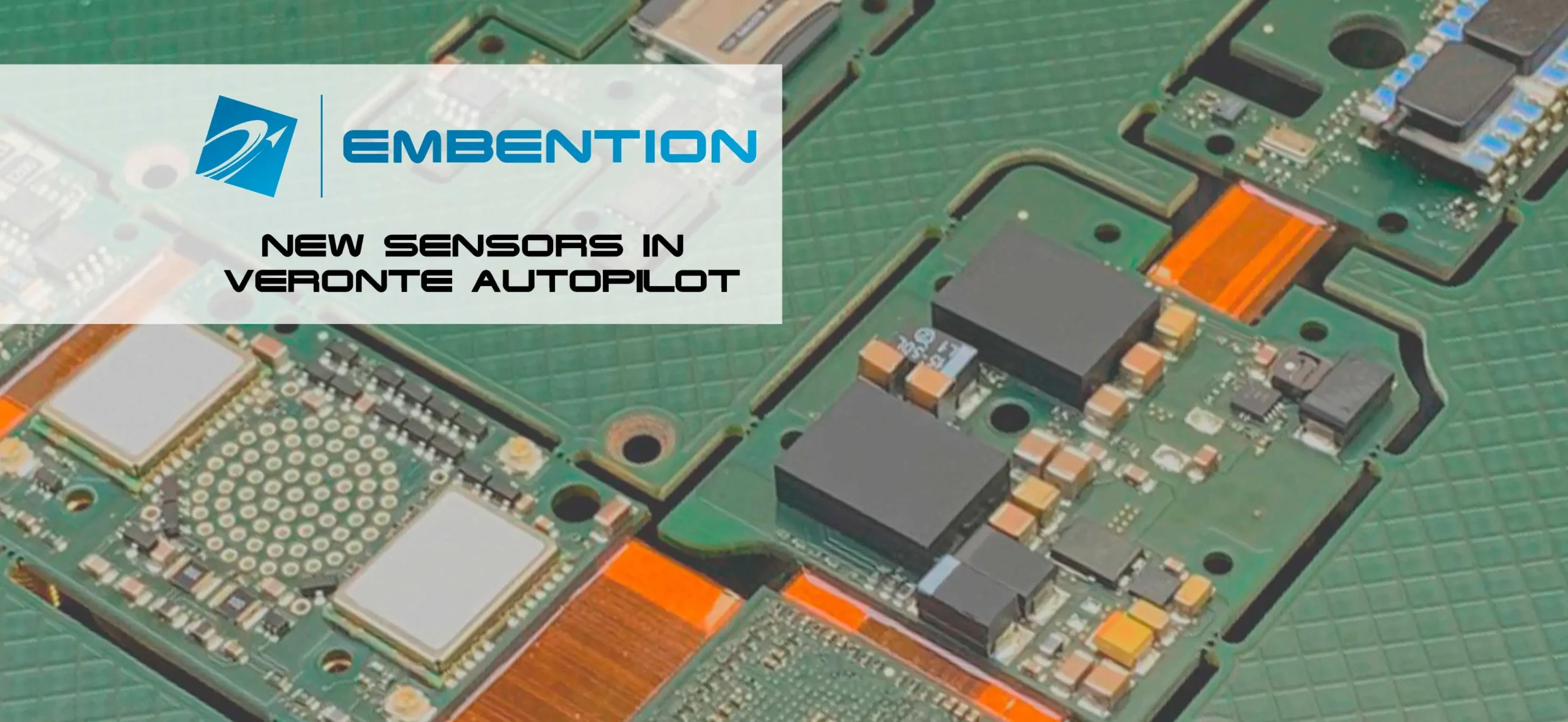
One of the most crucial tasks to keep Veronte as a state of the art Autopilot is to continuously search the market for the best sensors that can be included in the design. This is because the sensors are constantly evolving and their specifications have a great impact on the whole Autopilot performance, including the robustness and precision of the product.
Main advantages of new sensors
When a new sensor is proposed to enter in the design, it is usually because at least one of the following factors is fulfilled:
- Increased measurement range.
- Improved accuracy/resolution.
- Reduced instability/noise.
- Additional features, such as self-calibration or advanced on-chip algorithms.
- Enhanced temperature range.
- More restrictive hardware standards compliance.
All these factors have a direct and clear impact on product performance. The first impulse usually is to directly replace the old sensor with the brand new one. At Embention what we always try is to keep both, the latest and the previous version simultaneously, having redundant sensors allows:
- Adding new features meanwhile maintaining a robust and proven data source.
- More sources of reliable information, increasing the accuracy of the control algorithms.
- Redundancy implies less Minimum Time Between Failures (MTBF).
These aspects are very relevant for the reliability and confidence of an autopilot.
Most relevant sensors enhanced
In the newer version of our Autopilot, three of the most important sensors have been enhanced and in the three cases, the old ones have been left for redundancy. Below you can find the main features that each new sensor add to Veronte performance:
Magnetometer
- Internal degaussing (eliminates thermal drift and interferences from strong magnetic fields).
- On-chip advanced calibration and tilt-compensation algorithms.
Inertial Measurement Unit (IMU)
- On-chip vibration filter for low-frequency noise.
- Extended measurement range up to +-24g.
Pressure sensor
- Improved accuracy on the most used pressure range.
- Reduced temperature drift.
Conclusion
Including new sensors is one of the most important decisions to keep the Veronte Autopilot up to date because it affects directly not only the performance of the product (providing enhanced information accuracy for the algorithms) but it also has great benefits such as less MTBF.