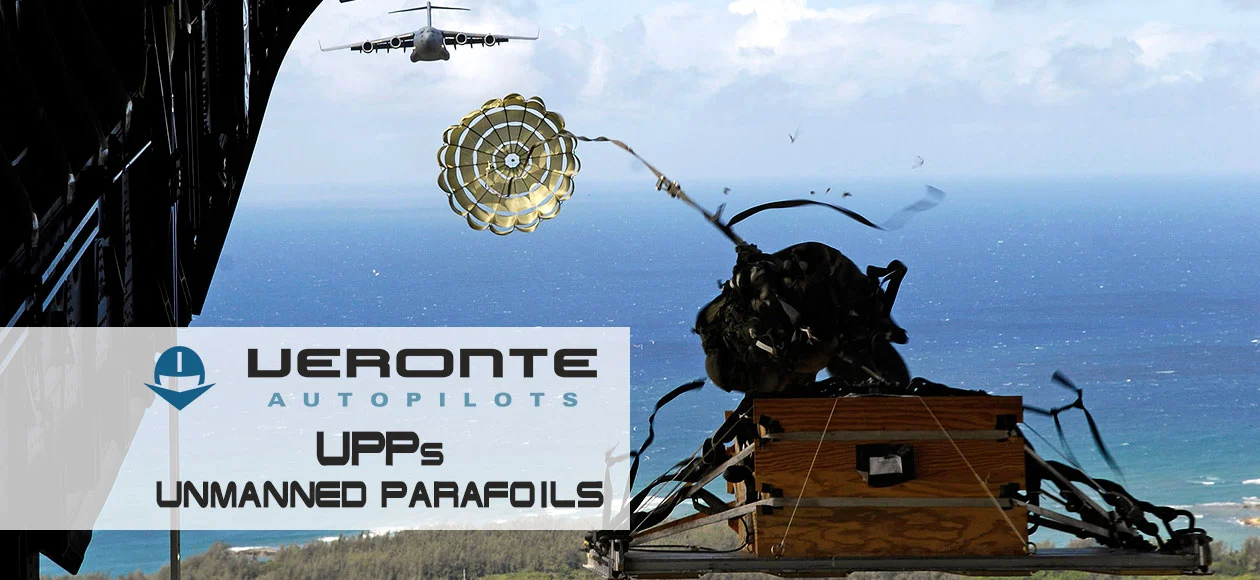
In addition to UAVs, more commonly known as drones, there are other types of Unmanned Aircraft Systems (UAS) with several layouts and possibilities. Being the guided parafoils or UPP key platforms for a wide range of applications. On these platforms, it is possible to control the flight path by controlling the position of the “aileron” formed in the rear side of the parafoil. This control surface is controlled by changing the thread strain on these surfaces, which controls the aerodynamic field around the Unmanned Parafoil, changing its trajectory.
The advantages associated with the use of guided parafoils or unmanned parachutes (UPP) are the capacity to deploy any type of load with highly accurate positioning. In addition, thanks to its avionics system, it can perform safe landings at an exact point, including flare-type maneuvers for precise positioning on the last stretch of the descent. These UAS permit to deploy loads, guided to unreachable locations with reduced spaces that otherwise could not be reached, as through defiles, wooded areas, etc.
UPPs are able to perform advanced maneuvers, such as obstacle avoidance or “follow me” flights. It is also possible to manually control the platform through the embedded radio link, permitting advanced flight control modes as the fly-by camera.
There are many civilian applications linked to the use of guided parafoils, such as sending medicines and food, messaging, logistics,… Without forgetting the corresponding uses in military applications, where, in addition to those mentioned above, would be added the supply of ammunition, weapons, fuel, tools, etc.
Veronte Autopilot 1x integration in guided parafoils and unmanned parachutes UPP
Veronte Autopilot 1x incorporates fully autonomous flight functionalities in guided parafoils, including advanced features, granting a high level of security and reliability in the mission, in addition to added functionalities. This professional autopilot controls the flight for both guided parafoils and unmanned powered parachutes, making them completely autonomous with high precision on navigation and landing. It can be adapted to any unmanned system and any control surface actuator.
Veronte supports the integration of a wide variety of payloads in the UPP and guided parafoils, significantly increasing system capabilities. Typical payloads that can be configured with the autopilot are: visible cameras, multispectral cameras, infrared cameras, flares, precision sensors, etc.
The Veronte avionics system has already been successfully integrated in UPPs, recently on the Perigeo project, in collaboration with companies like Elecnor-Deimos or Aernnova, where it is controlling a guided parafoil using advanced GNC (Guidance, Navigation, and Control) algorithms.