

Embention Showcases Latest Defense Innovations at MSPO and UNVEX
Embention presents Veronte KAI upgrades, expands defense partnerships, and showcases autonomous flight avionics at MSPO Poland and UNVEX Spain.

January 8, 2026
In the aerospace industry, uncertainty represents the ultimate risk to mission success and safety. The traditional challenge of software variability (where code behaves differently depending on the compilation environment), poses a significant threat to critical systems. By implementing deterministic compilation and automated CI/CD pipelines, the industry is moving toward a “shielded code” approach. This methodology ensures that every line of software governing UAVs and eVTOLs is predictable, traceable, and ready for the most rigorous certification standards.
For decades, software engineering has battled a persistent ghost: environmental variance. In the context of critical avionics, the phrase “it worked on my machine” is not just a frustration, it is a catastrophic vulnerability. If two different computers compile the same source code but produce slightly different binary outputs due to varying compiler versions, timestamps, or system paths, the integrity of the flight controller is compromised.
In aviation, the enemy is any hidden variable. When dealing with autonomous systems, the goal is to achieve a state where the software is “blindly” consistent. This level of precision is mandatory for systems where a single bit-flip or an unverified library could lead to a loss of control during flight operations.
The technical cornerstone of reliable avionics is deterministic compilation. This process ensures that, given the same source code and configuration, the build process always produces an identical binary file, down to the last byte. To visualize this, one can compare it to a high-end digital kitchen: no matter who presses the button or what the room temperature is, the machine follows a programmed sequence to produce the exact same loaf of bread every time.
Embention utilizes dedicated Continuous Integration (CI) servers that act as a controlled, sterile environment for code. By isolating the build environment, these servers eliminate external influences. This technical rigor ensures that the software flying a drone in the field is exactly what was verified in the laboratory, providing a mathematical guarantee of consistency across the entire production lifecycle.
The era of relying solely on human review to catch critical flaws is ending. While expert oversight remains vital, automated CI pipelines now serve as the first line of defense. These systems are programmed to “block the build” if they detect security vulnerabilities, excessive code complexity, or non-compliance with aerospace standards like MISRA C.
This automated gatekeeping acts as a continuous audit. If a developer introduces a segment of code that is too complex for reliable testing, the CI system rejects it before it can ever reach the compilation stage. By integrating static analysis and automated unit testing into the development heart, the software evolves within a protected framework that prioritizes safety over speed.
Beyond technical safety, these processes offer a massive commercial advantage: simplified certification. For manufacturers of UAVs and eVTOLs, navigating aviation certification requirements is often the greatest barrier to entering the market. A deterministic and automated workflow provides an unbroken chain of evidence, showing exactly how, when, and where every piece of code was generated.
This level of traceability transforms the certification process from a manual uphill battle into a streamlined verification of logs. It reduces time-to-market and builds immense value for program managers who need to prove the reliability of their platforms to stakeholders and regulators.
Embention does not simply manufacture autopilots; it manufactures confidence through high-quality software engineering processes. By integrating Veronte Autopilots with these rigorous CI/CD standards and deterministic builds, the company ensures that every flight is governed by code that is as resilient as the hardware it controls.

Receive news & updates
Embention presents Veronte KAI upgrades, expands defense partnerships, and showcases autonomous flight avionics at MSPO Poland and UNVEX Spain.
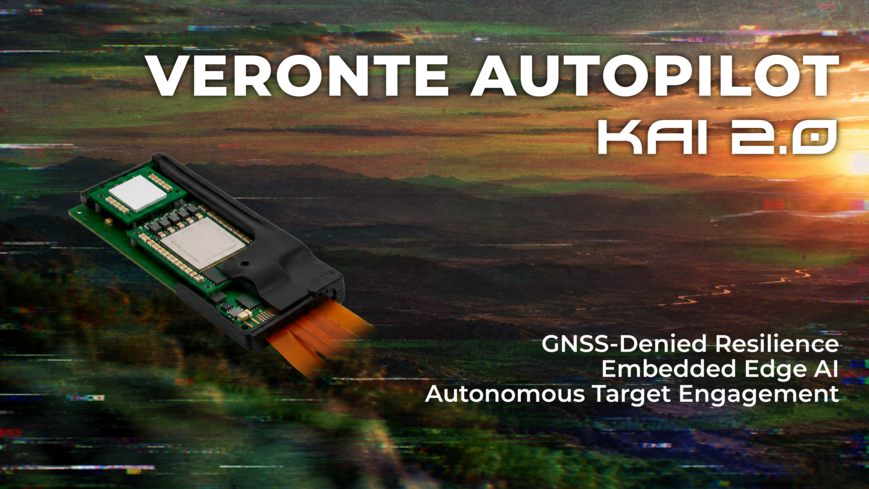
Discover Veronte KAI 2.2 with AI-based PNT, terminal guidance and scalable production for one-way drones in contested environments.

The iMEDCAP consortium proudly announces the successful completion of the live pilot demonstration of its autonomous tactical medical evacuation system at NATO’s Vigorous Warrior 2026 exercise.
